
Real-World Learning Works


A teacher recently shared a story that stopped me.
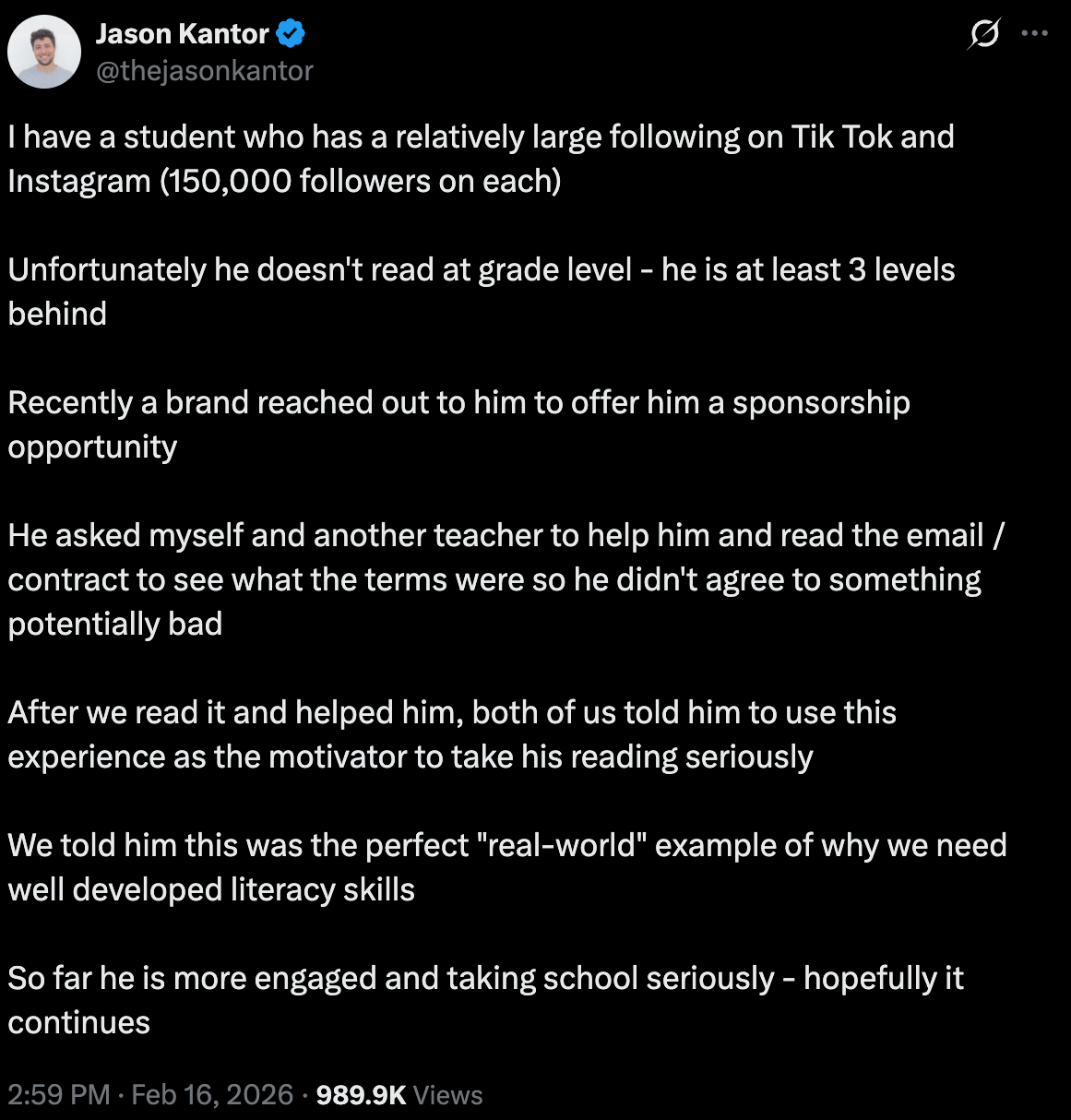
One of his students has 150,000 followers on TikTok and another 150,000 on Instagram. The student is also reading 3 grade levels behind.
A brand reached out to offer him a sponsorship deal. He didn’t know what to do, so he asked his teachers for help. He needed someone to read the contract and make sure he wasn’t agreeing to something he would regret.
They read it with him. They helped him understand it.
Then they told him the truth: this is exactly why reading matters.
He is more engaged now. He is taking his education seriously.
Because it finally meant something.
The Problem With School as We Know It
Most kids cannot connect what happens in a classroom to anything that matters to them.
They read passages about topics they didn’t choose. They answer questions about characters they don’t care about. They are told that one day this will matter.
But “one day” is not motivation. It never has been.
That student with all those followers? He is building something real. He has an audience, a brand, and now a business opportunity. And in the middle of all of that, he discovered that the skill he most needed was one his school had been trying to teach him for years.
He just didn’t know why.
Now he does.
What the Science Actually Says
Researchers who study motivation and learning have a name for what happened to that student. They call it relevance.
When learners can see a direct connection between what they are learning and something that matters to them personally, engagement increases dramatically. This is not a theory. It is one of the most consistent findings in educational psychology.
Edward Deci and Richard Ryan’s Self-Determination Theory identifies three core drivers of human motivation: autonomy, competence, and relatedness. Real-world learning activates all three at once.
The student chose to pursue his social media career. That’s autonomy.
He needed to become more literate to protect himself. That’s competence with a real cost attached.
He had teachers who cared enough to sit down with him and walk through a contract. That’s relatedness.
When those three things come together, something shifts. Learning stops feeling like something that is done to a child and starts feeling like something they actually want.
What This Means for Your Child
Here is what I have seen across 14 years inside schools, as a teacher and as a principal.
Kids who struggle are not lazy. They are not incapable. Most of the time, they are simply waiting for a reason.
The reason does not have to be dramatic. It does not have to be a sponsorship deal or a viral moment.
It can be cooking a meal and needing to read a recipe. It can be building something and needing to measure. It can be starting a small business and needing to write clearly.
The trigger is almost never the content itself.
It is the meaning behind it.
When your child knows why something matters, they will do the work. Not because they are told to. Because they want to.
Are you enjoying this article? Please consider becoming a paid subscriber.
We Are Building Something Different
My wife and I are building our school because we believe this problem is solvable.
Not theoretically. Practically.
Children, especially teenagers, are capable of far more than most schools ask of them. We believe that when kids understand why something matters, they rise to it.
That student with the sponsorship offer proved it.
He is more engaged now. He is taking his reading seriously. Because it finally meant something.
That is what education should feel like.
The Question Worth Asking
If your child came home today and said school felt pointless, what would you tell them?
Most parents say what they were told. “It matters. You’ll see one day.”
But what if they didn’t have to wait?
Why isn’t the meaning built into the school itself?
That is the question my wife and I are trying to answer. And it is the question every parent deserves to ask of their child’s education.
Your child should not have to stumble into a sponsorship deal to understand why reading matters.
It should be built into their education every single day.
If this work is helpful to you, I invite you to subscribe. And if you find it valuable, consider becoming a paid subscriber to support my writing.
It does and it’s important